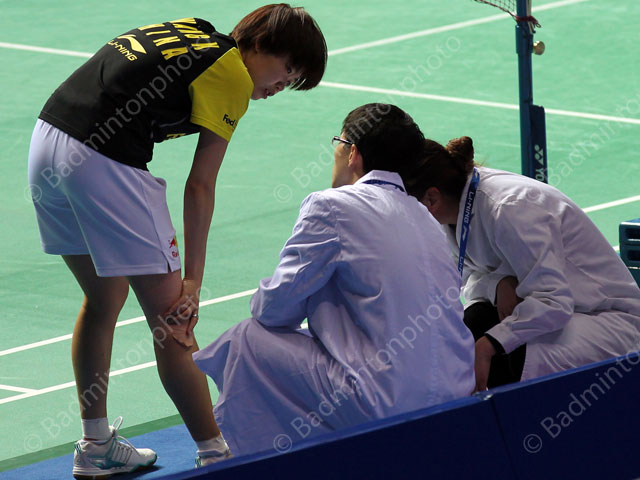
The Badminton Super Series Finals have just finished, showing China’s supremacy over the sport with 4 titles scooped out of 5 possible. In these Super Series Finals – for the highlight of the season – one women’s doubles semi-final was not played, between the pair of Wang Xiaoli / Yu Yang and Tian Qing / Zhao Yunlei. Detailed analysis of 2011 badminton results shows that walkovers and retired matches have been common between Chinese compatriots throughout the year.
Statistics compiled from the results of the main draws of all individual tournaments played in 2011 – Grand Prix, Grand Prix Gold, Super Series (the top three levels of competition in the Badminton World Federation’s (BWF) regular calendar) along with the BWF World Championships and OSIM BWF World Superseries Finals, show that more than 20 percent of matches is either not finished or not played when Chinese shuttlers play against their own compatriots. Chinese shuttlers met each other 99 times on the circuit this year, and 20 matches were either not played at all (11 walkovers) or played partially before one of the opponents retired (9 retirements). This shows that 20.20% of matches between Chinese shutters were not completed in 2011.
0.74% of matches uncompleted between China and other nations
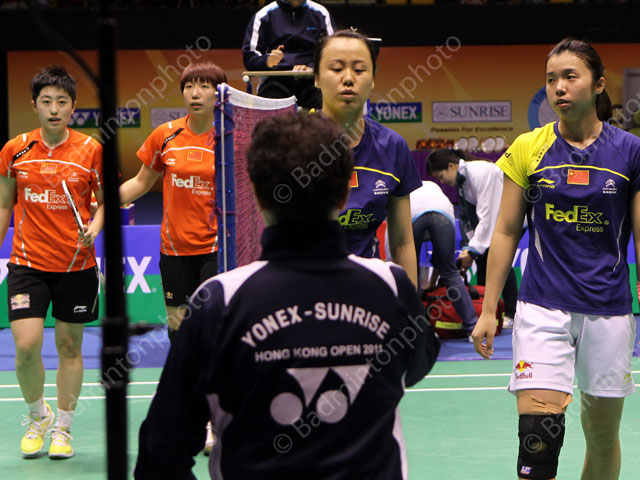
Statistics have also been compiled for when Chinese shuttlers play other nations. When Chinese shuttlers meet non-Chinese opponents, the percentage of withdrawals drops to 0.21% (2 matches out of a total of 943 matches) and retirements drop to 0.53% (5 matches out of 943 matches), for a total of 0.74% of matches not completed when China plays another nation.
When other nations play compatriots…
Corresponding numbers have been compiled to highlight the numbers and statistics when players from nations from other than China play against their own compatriots. In this case, the statistics show that out of 190 matches played between compatriots, 10 were either not played or not finished, which means 5.27% of matches not completed between compatriots. (Amongst these 10 matches, 5 were between Koreans, 2 between Malaysians, 2 between Indonesians and one between Germans)
These figures have to be put in perspective as China has the largest contingent of players at high level – more than a third of the matches played between compatriots (99 of 289 matches) are played between Chinese shuttlers. Never the less, it has raised some questions amongst the badminton community.
After complaints were made by some National Federations and some players about these large numbers of withdrawals, the Badminton World Federation issued a statement on August 15th, 2011 regarding measures to be taken should there be any sign of irregularities. That statement reads:
“A special assessment will be conducted for any main draw matches between players from the same country. This will include special focused monitoring by the tournament referee or other BWF officials, whereby all of these matches from the quarterfinals onwards (and possibility of earlier stages) will be taped to ensure necessary documentation is on hand if irregularities are suspected and flagged for a review by the BWF disciplinary committee.
If compelling evidence is found of any irregularities, the matter will be treated with the utmost gravity by the BWF and severe penalties will be imposed.” [see full statement]
As of December 15th, no penalties have been issued by BWF to any nations on such grounds but the world governing body is still monitoring whether cases should be taken to a disciplinary measure.
The Statistics were compiled by Badzine (thanks to Loh Shih Ying) based on the official source of results www.tournamentsoftware.com for all 12 Super Series tournaments, 15 Grand Prix / Grand Prix Gold events, the Super Series Finals 2011 and the 2011 World Championships – a total of 29 tournaments and 4648 matches.
Here are the full statistics :
Annex 1 : Statistics China vs. China
Annex 2: Statistic China vs. Non-China
Annex 3 : Statistic Non-China vs. Own country
Annex 4: Statistic Non-China vs. others
No related posts.


Well done Badzine for compiling the statistics which are quite remarkable! There is clearly a problem for BWF but finding a solution is going to be very difficult. China is now so dominant in the game that its players will inevitably meet each other frequently (especially in the crucial final stages of tournaments) and is therefore in a unique position to influence ranking points and above all Olympic qualification. They clearly have no qualms about doing this. The best solution of course is for the other nations to raise their game and provide a greater challenge on court and thus reduce China’s dominance but this is unlikely to happen. BWF talks about severe penalties but so far this has only been talk. Perhaps it is now time for action.
This article is pointless. If there’s something wrong about all of those withdrawals, then why can’t BWF find something to do? I mean, in every tournaments there were doctors/medical team, and also BWF representation, right? So until BWF can find a way to avoid this, maybe it’s better to stop talking/writing about this topic, because it’s completely useless.
Dear Bagas,
Our job, as reporters, is to highlight facts in order for people to be able to step back and analyse better what the situation is. This article is just about facts, nothing else. And we believe that if we, press, stop talking about things that go wrong, it surely won’t help things get better. This is our responsibility. Some other have theirs to prevent it or make it stop.
Bagas, i’m sorry but you have totally missed the point, the article is firstly to reveal the facts about suspicion of Chinese conduct in badminton torunaments, secondly to raise awareness. One thing missed out from this article is what i call the “fake games” where the Chinese play each other but clearly do not play to their full extent or as my Chinese friends who are coached by ex-national players say there is another rule. This rule is on matches that are fixed, both Chinese players (especially womens singles) are asked to fully contest the first set of the match, and whoever wins the first set deserves to win the match, and the compatriot who lost the first game will fold and give away free points. This is to keep the winning compatriot non-fatigued for their next match. I have seen countless victories between chinese oponents that look like this, 21-19, 21-6. How do you expect the BWF to deal with this? Can it be proved? Suppose, as a a badminton fan, you know when one of the Chinese shuttlers is nowhere near their best, classic example, Lin Dan 2008 AE final, can you prove that he wasn’t injured? For now, the only solution left for the good people in the badminton media, yes all of you at Badzine, is to keep the fans aware and knowledgeable about what is happening to our beautiful sport.
Of course, as Raphael mentioned, this article is about facts and nothing else, they speak for themselves.
Hats off to you Badzine! Fact is a fact. The above mentioned things did happen. I write this comment even before I had read. “fake games” Like Deen mentioned, cant be avoided untill other nations pull up their socks with proper challenge. Iam not sure how far these topics with respect to All-Chinese affair will be in spotlight after Olympics 2012.
Who gives a crap about what you guys think about China? Firstly, well done on the wonderful piece of article and i really appreciate reading such detailed compilation of the statistics. However, some of these comments have undertone of the jealousy seeing how dominant China is in this the sports.
China has pulled these bold stunts to show how fast badminton is evolving as a competitive sports and the emergence of new threats to undermine their position. I remember Lin Dan got blasted with boos and criticisms after the Singapore Open fiasco. Well, he won the World Championship eventually, silencing every critic or troll that doubts his ability to match Lee Chong Wei.
At the end of the day, China has the last laugh after all while the ranting goes on about their winning strategy.
The article premises is stupid to begin with..
Comapring an extreme amount of CHN vs. CHN. meetings with a handful INA vs. INA etc. KOR vs. KOR meetins etc. is really comparing APples and bananas…
Relationship Between Variables
It is very important to understand relationship between variables to draw the right conclusion from a statistical analysis. The relationship between variables determines how the right conclusions are reached. Without an understanding of this, you can fall into many pitfalls that accompany statistical analysis and infer wrong results from your data.
by Siddharth Kalla (2011)
There are several different kinds of relationships between variables. Before drawing a conclusion, you should first understand how one variable changes with the other. This means you need to establish how the variables are related – is the relationship linear or quadratic or inverse or logarithmic or something else?
Suppose you measure a volume of a gas in a cylinder and measure its pressure. Now you start compressing the gas by pushing a piston all while maintaining the gas at the room temperature. The volume of gas decreases while the pressure increases. You note down different values on a graph paper.
If you take enough measurements, you can see a shape of a parabola defined by xy=constant. This is because gases follow Boyle’s law that says when temperature is constant, PV = constant. Here, by taking data you are relating the pressure of the gas with its volume. Similarly, many relationships are linear in nature.
Relationships in physical and social sciences
Relationships between variables need to be studied and analyzed before drawing conclusions based on it. In natural science and engineering, this is usually more straightforward as you can keep all parameters except one constant and study how this one parameter affects the result under study.
However, in social sciences, things get much more complicated because parameters may or may not be directly related. There could be a number of indirect consequences and deducing cause and effect can be challenging.
Only when the change in one variable actually causes the change in another parameter is there a causal relationship. Otherwise, it is simply a correlation. Correlation doesn’t imply causation. There are ample examples and various types of fallacies in use.
A famous example to prove the point: Increased ice-cream sales shows a strong correlation to deaths by drowning. It would obviously be wrong to conclude that consuming ice-creams causes drowning. The explanation is that more ice-cream gets sold in the summer, when more people go to the beach and other water bodies and therefore increased deaths by drowning.
Positive and negative correlation
Correlation between variables can be positive or negative. Positive correlation implies an increase of one quantity causes an increase in the other whereas in negative correlation, an increase in one variable will cause a decrease in the other.
It is important to understand the relationship between variables to draw the right conclusions. Even the best scientists can get this wrong and there are several instances of how studies get correlation and causation mixed up.
Read more: http://www.experiment-resources.com/relationship-between-variables.html#ixzz1hPLuzOK8
Speaking of questionable premises, where does it say that the article seeks to compare China-China with Indonesia-Indonesia? And where is there any claim to statistical rigour? This is simply a presentation of the facts. Many badminton fans had been chafing this year at matches not being played because of walkovers, with lots of allegations made. At the same time, as all players seem to be playing well above their normal frequency of tournaments, walkovers have been happening all over, including when Chinese players play members of other teams and that begged the question as to whether the rates were actually different.
Thank you for that collection of interesting definitions, though, and the attempt to trivialize these numbers is at least encouraging. If there were an actual causal explanation for the unfinished matches that would make the allegations of unfairness that we’ve been hearing all year sound as ludicrous as the ice cream/drowning example, then this would truly be wonderful to hear.
By the way, in the case of Korea-Korea matches, they are not exactly a handful. There were 54 such, post-qualifying, in just the two Korea Opens alone. But your point about the numbers not being comparable is still possibly valid as it would make sense to take into account at what stage of the tournament they happened. That is, if one were trying to compare, which this article does not.
It is fruitless to compare apples with bananas..
I’ve Watched an unmotivated Taufik get trashed by players he should easilly beat if he had “tried”.. He is still a hero to me. I do not think there is a way to enforce “best play”..
In the end there must be enough money and prestige for players to WANT to win.. If we set up a system which just competes for ranking points, position and olympic qualification points. WOs is what we will get.
I just don’t see how people expect players to go all-out maybe risk serious injuries etc. for an unimportant, low payout, low prestige tournament.
@Lamps – jealousy does not play a part in any of my attitude to what i previously posted I admire the Chinese for their badminton talent ability and sheer class, however everything that is good and great about the Chinese Badminton Association in my/our beautiful sport of badminton, with non sporting conduct. Remember that every tournament played is a competition, and there seems to be no competition when matches are fixed, how dare any country belittle the authorities with foulplay, and think of all the other countries who strive hard to get ahead slowly, and think of all those fans who pay good money to watch matches live/ tv subscriptions that do not get their money’s worth? It’s not about comparing Lin Dan to Chong Wei, it’s about comparing China to other countries in the match stats, not which players are playing, these stats reflect on the Chinese Badminton Association and not the players.Look at this article http://news.ninemsn.com.au/article.aspx?id=416666 where foulplay is admitted by Li Yong Bo, and as a result a player had quit the national team following the Olympic Games, now what do you propose to that? or is this fine in your books as part of China’s winning strategy? It’s disgraceful to our sport that the players are treated as such, without them, the BWF wouldn’t exist, and neither would our entertainment be provided. Thanks again to Badzine, who are loyal servants to our sport, and show things how they are.
********is tainted with non-sporting conduct******
This is obviously another comment written by a typical fan who does not understand the spirit and the importance of prioritising national interest over the individual interest. Let me put it to you this way: Suppose you have two players representing the same country in the semifinal and Lin Dan on the other semi slot, logically you would prefer to let the best person of the two to face Lin Dan in the upcoming final.
At this instance, nobody will stand in ceremony to take in account of the sportmanships and the reputation of the sports. As a coach with the responsibility to make sure your country would have a chance to win, strategy takes over the interest of the sportsmanship. Personally i would do that, I don’t know about you but i am sure everyone would do so because it’s the country’s pride at stake, no one will give a crap about the love of the game. We will do whatever we can to our best of our abilities to win.
Take one example for instance, the all-Japanese affair in the first semifinal of the All England tournament 2011. Instead of letting the best pair to face the nearly-invincible Chinese pair, the coach let them play to their full strength to determine the best pair win. They were obviously proven wrong when they were owned so badly by the Chinese pair. It was really stupid on the Japanese end to be honest had they employ the same tactics as the Chinese side. They might feel it is an honourable thing to do but in my opinion or perhaps in the opinion of those who wants JAPAN to win China so badly would think they are stupid to let the weaker pair go through only to be defeated in a lop-sided final. So please stop bashing china for their strategy, other teams did the same thing and they got away from Badzine attacks because they are a lesser nation.
We will see more walkovers in the future tournament. Till then, have a good New Year and long live the Great Wall of China
I think it is quite obvious that some of the walk-overs between chinese players were a result of strategic planning, mostly for the sake of olympic qualification. And sometimes, it is probably also true that the tournaments in question were simply not so important. However, nobody has addressed the following point, i.e., whether it is fair to have a player ranked no. 5 in the world, yet he won’t even have a chance to play at the highest stage of the game (the olympic games), simply because there are two other compatriots of his ranked higher than him. To me, the current rule is a bit arbitrary, and led directly to many walk-overs, especially in games involving chinese men’s singles players. I would have loved to have been able to seen those games being played, but I also would have loved to see the best players being able to participate in the olympic games. I find it hard to blame the chinese badminton association to try this maneuvers, since the rule they were obviously trying to navigate around was not exactly fair in the first place.
Dear Lamp
You’ve highlited an important point in your comment.
“….who does not understand the spirit and the importance of prioritising national interest over the individual interest”
The question is : Is badminton an individual sport or a team sport ? Is it like football, handball, basketball, or is it like boxing or tennis ?
Are competitions like Thomas Cup, Uber Cup, Sudirman Cups not the ones where the patriotism should come in first and all the players fight for their nations, and leave the other events for individual competition, between human being and not countries ?
Maybe a solution would be to implement a team event in the Olympics, on top of the 5 individual events. And ask every country to play the game as it should. As a nation for team events and as regular individuals for individual events….
Again, you have clearly missed the point of letting the athletes do what they are paid to do, compete to earn their money and ranking point fairly, not becom slaves to any badminton association, you mentioned that the weaker pair got through to all england final of 2011, how is this so? did they not EARN that position? win or lose, comfortably or closely, they deserved to be there in that final. And let’s mention another stat here for you, do you think it’s fair that Lee Chong Wei had to play against a fresher Lin Dan after hehad to play Lee Hyun Il in 3 COMPETITIVE sets for the Olympic semi whilst Lin Dan was given “training” (mentioned by commentators) by Chen Jin in his semi-final? You mention the countries having pride due to their wins and sucesses, Badzine I am officially asking you to conduct one of those fantastic voting polls to see what the badminton world think of china’s pride. You mentioned “At this instance, nobody will stand in ceremony to take in account of the sportmanships and the reputation of the sports” – well, we shall see about this in the very near future, and then also “As a coach with the responsibility to make sure your country would have a chance to win, strategy takes over the interest of the sportsmanship” i’m sorry but no, absolutely no, you want to talk about chance of winning? i’m from England, where the players here are hel in high-esteem but we really have no strenght like China, currently in the highest paid event, we have Raj at 24 in the world, Carl Baxter at 54 and that’s it for the top 100, CHINA HAS MORE PLAYERS IN THE TOP 5 than England do in the top 100! and you talkabout chance of winning! When China have a qualification pair of Zhang/Zhao winning the All England 2010 and new pair winning Xu Chen/Ma JIn winning it for 2011, please do not ramble about best chance of winning, China are already there with the BEST chances of winning without foul play. @Raphael, I’m not sure if this would work as the ability to still manipulate individual competition is there, but yes, as patriorism was mentioned, it would be the best opporunity to display it.
You think Lin Dan is the type of person who wants easy victory? Unfortunately you are wrong, Lin Dan had the toughest draw as well as Lee Chong Wei in the Olympics Games unlike Taufik back in Athens who played against a one eyed-jet player in the final, no Chinese players at all to challenge his march. I would still call Taufik’s win back in Athens a fluke as he didn’t truly deserve to win it because he didn’t face the toughest opponents in his path (well only one who was Peter Gade who always choked in major tournaments).
In case you dont know, Lin Dan is an individual who wants to truly win a tournament with his own merit, plus any help from any quarter would come in handy as a bonus. Too bad for Chen Jin who had to let Lin Dan through to the Final because Chen Jin shouldnt be there in the first place hence he was indebted to Lin Dan for making too many sacrifices for his sake. Lee Chong Wei would still lose to Lin Dan in a one-sided game because some people didn’t realise how godly the player was throughout the tournament even if it was on the fair ground. From time and time again, Lin Dan had showed us he is the true world number 1 by winning the matches fair and square, as evident from his Four-world titles and Olympics Gold medal.
Whatever cards LYB wants to play on the field, it’s entirely up to him which has totally nothing to do Lin Dan at all. All he cares about is winning on his end and at the same time be a team player ! You will never understand what it is like to be in Lin Dan’s shoes.
That’s because none of your Brits in men’s singles can beat Lin Dan in any occasion. If in an ideal situation where Lin Dan fares poorly against Rajiv compared to Carl, Kenneth Jonassen would do what’s best for interest of the Country he worked for plus his job to let the best Rajiv to face Lin Dan should Rajiv had to battle Carl in the same match before facing Lin Dan. It all comes down strategic gameplay at the end of the day.
Why would I let Player B instead of Player A to fight Player C if statistically Player C had been beating Player B all the time in the past? In the Olympics scenario, I would be condemned or prosecuted by the nation for acting foolishly to see the Gold medal be given away easily to my opponent because i let the weaker player to face the opponent eventhough he made it fair and square. Sometimes in life, we have to act according to the situation and try to play to our advantage. That’s the way of life.
I really do think you are totally fooled, if all the top players enter a tournament, the one who wins deserves to win the title if no matches are fixed to the winners advantage! No, Taufik didn’t face the top Chinese as the “godly” Lin Dan lost to Ronald Susilo and Chen Hong lost to the “one eyed jet”, if the top players lose to players who are playing better than them in that tournament, as you mentioned LD in 2008 Olympics, they deserve to be there. I now believe your are talking utter nonsense, Why shouldn;t Chen Jin be there? You have just contradicted yourself, Chen Jin was indebted, as you said before, there patriotism is more important than the players, you have clearly not thought out your argument. And as for Chen Jin reaching the Olympics, this is LYB’s doing, which you apparenlty highly approve of his methods, so why shouldn’t Chen Jin be there? And to talk of Lin Dan as a god is complete nonsense aswell, how is it, in the 3rd game of a final between him and LCW he was 20-13 up and lost the match? And you talk as if you know Lin Dan, do you know what it is like to be in his shoes? Let me guess, you caught one of his shoes in the Beijing games right? No, I used the british players as an example, the same goes for any single other country in the world, China are already advantaged by their sheer strength, they do not need foul play, to stand a “chance of winning”, now there are 2 players in China who can say they have beaten Chong Wei consistently, what more chance of winning do they need? And please don’t insult disabled players ever again, Shon Seung Mo did fantastically well to grab a silver medal in 2004, he did better than your “two-eyed jet” in that tournament, and also, just to brush up your badminton knowledge, in a straight knock-out tournament, whoever plays the best over the week, WINS! so please, do not speak of any more flukes, as there is a difference between losing, and being beaten, classic example Rasmussen/Paaske AE2010.
Whatever beats Lin Dan makes him a lot stronger than before. The match between him and LCW is the one he will never forget for the rest of his life. China will once again silence you all in the coming 2012 just like what they did to you foolish fans who are full of hypocrisy and double standards in criticising Lin Dan in Wembley.
Please Shon Seung mo is not a good player ? Even my local and underachieving player Wong Choong Hann who happens to always choke against XiaXuanze/Bao Chunlai can beat him hands down . Please dont mention Chen Hong in this argument. Chen Hong is the most useless player and the biggest mistake LYB had ever made in his decision to field the third Chinese player. In summary, the whole campaign of MS singles was a disaster with XiaXuanze being dropped and Taufik benefited from it. LYB learnt from this and he will never make the wrong decision again the in future.
Believe me I ain’t big fan of China, I just dislike watching fluke wins but that’s how it works in sports, you win some you lose some.
I could say the same for Ji Xinpeng’s victory against Hendrawan. The gold medal should rightfully belong to Hendrawan since he played the most beautiful and deceptive badminton i have ever seen in the OG2000 but he fell short of stamina because he had a tougher draw, Ji was the lucky man that match.
So please don’t question/challenge Lin Dan’s credibility as the true world number 1. He has proven you fools wrong from time and time again and he will do so in the near future. So save your breath and flaming comments on your local players to improve your game instead of aiming at China’s dirty tactics all the time. Peace
Your views on the player’s individually in hypothetical circumstances are fair as they are our own to make, I do not agree with most of them. I’m sorry but I cannot see how a 2 time All England champion and 3time finalist is a bad excuse for a third player? HAHAHA in fact he beat your beloved Lin Dan in probably on of the only fair Chinese vs Chinese match I’ve ever seen hahahaha- If you read the above comments, nobody at all says even once that lin Dan isn’t the world’s greatest player, I in fact think that he is, and that he is most definitely the best player in the entire history of badminton. This article isn’t about Lin Dan, it’s about the Chinese Badminton association’s conduct, method and tactics, do you not understand that? not even a little bit? Nobody is questioning Lin Dan’s credibility, on the Chinese Badminton Association, and how do you question credibility? Well, as Rafa has done, you compare this association to the rest, you still do not understand.
So what’s bwf going to do, legislate that a player has to try harder during a match? Should bwf put a doctor and judge on the sidelines to make sure a player is really hurt? It’s laughable. First of all, if a player throws a match or withdraws, that’s his or her right. When Taufik doesn’t get his way in a match many a times he throws the game with a half assed attempt, isn’t that throwing the game? How about the numerous times ive seen kkk and tan quit trying when the going gets rough in certain games?
Bottom line is, what the Chinese badminton federation does with it’s players is THEIR BUSINESS. It’s not like their forcing other players from different nations to lose games. Who is to say that if they tell a Chinese player to lose to a fellow teammate..that that teammate will go on to win the tournament? Players get walkovers in the game all the time.Getting a walkover doesn’t guarantee you will win the whole tourny. After all, BAM can do whatever they want with their players.No one in the china badminton Association cares about what BAM does with it’s players, or what Denmark does with its players. So why the hell should bwf care what China does with it’s players? Sounds like a whole lot about nothing but sour grapes to me, ladies. Chinese players play for their COUNTRY FIRST, THEMSELVES SECOND. That is something the other badminton countries have yet to grasp. Just because you think of yourself before your country doesn’t mean another person has to think the same way too.
Dear Yonbo,
You have a point. China should be able to do what they want.So could every nation, and put the nation’s interest first. But then, you’d have to get the point of view of TV broadcasters and spectators who pay some money (sometimes a lot) to see… a walkover. Or a pre-decided match. Maybe these broadcasters or spectators would not agree with you. And might just go and cover/watch Wrestling instead, where the faking is what the sport is all about…
Hi, Great article and discussion. It appears to be missing a major statistic for comparison however, which I’d be interested in seeing reported:
What is percentage of all games that are unfinished/walked over (regardless of countries)?
This is important, as if 20.20% of all matches are unfinished/walked over, then it is not a problem when China plays China, its mearly the normal rate. I’ve a suspicion it’s nowhere near 20.20% though, and probably about 10 times less!!
Thanks,
Conor,
London
It’s true that that statistic is not explicitly presented. However, it is easy to get an idea. The attached .pdf’s show your four basic, mutually exclusive scenarios. The other three scenarios show non-completion rates of 0.73%, (when Chinese players play those from other nations), 5.27% (when non-Chinese players play those from their own nation), and 1.99% (when non-Chinese players play those from countries other than their own country and other than China). So you are correct. If the highest rate from among the other 3 possible scenarios is 5.27%, then the overall rate must be far below 20%.
Double standard comments…As if the Chinese gives a crap about what you guys have to say, I wonder if you all are really badminton enthusiasts or some people who are at leisure writing using patronising words like “sportsmanship”, image of the sport etc to justify their comments. Who cares anyway. No wonder badminton is made unpopular in places like Europe and USA, partly thanks to the mentality of you people with your lovely biased comments. Well, we play our own game and we are happy whenever we win.
Dear Lamps
If you don’t care about reading about “patronising articles and comments”, feel free to visit other websites, those who do not question anything, who take everything for granted, who do not raise issues which are important ones – to our belief anyways.
As for your last comment, if you (or China) play your (their) own game and happy when you (they) win, then, maybe some people in the IOC will realize that and take Badminton out of the program; And that would be a shame. For the wonderful Chinese athletes in the first place, and all the others.
FEEL THE WRATH OF RAFA!!! haha yes none of us are badminton enthusiasts at all, none of us play at a good level, we don’t even know what badminton is, it’s not as if some of the people who have commented on here have a full-time career in badminton and are friends with the top players in the world, or leaders on the only badminton based charity, or have Olympic and World and All England champions endorsing it, sure we know nothing about badminton hahaha – Lamps you must be very upset, that you (they) didn’t get a 5 title sweep in Korea ouch, it would be the worst thing to happen to badminton if it was removed from the Olympics
At the end of all this, the point here is that China’s dominance of the sport is detrimental to the popularity of it, and if this continues, badminton may not be featured in Olympics in the future.
There is no clear solution to this as different people has different agenda, national interest, individual glory, sponsor ad, spectators and tv audience expectations, etc, all have different needs.
At each major tournament, watching the lone LCW fights against the mighty Chinese is like a battle of David and Goliath. Ironically, this scenario makes the sport interesting now. I dread the day when LCW retires and all we see is China making a clean sweep at all majors.
so true…
after all the real issue is the dominance of China is killing the popularity of the sport…
though, i dun think can blame China for this manuever coz the system is quite unfair…
i mean, Chen Jin is regularly in top 5 and and not letting him play in Olympic is a bit cruel…after all it’s the dream of all athlete to compete in Olympic…
i think bwf should change it to max 3 NOC if they r in top 8-10…
seriously, the Olympic should be a place for the best of best players to compete…
do u guys want a final without LD or LCW???
not me…the 2011 world champ between LD and LCW is one of the best match i ever watch…
so what if China sweep all the medals…it just means that other need to buck up…this is how real world works…
And finally, maybe bwf can ask China to take a sabbatical break for a few years after the Olympic ???LOL
let’s see if that’s a gud way to develop the sport…
afterwards, we can ask China back in 2015 b4 the next Olympic???
the truth is that China is a superpower in Badminton…
even when LCW defeated LD , ppl will just say that LD is the better player and LCW did not deserve it…
seriously, ppl need to be relax and enjoy the game…and not too obsessed of who wins what…
the chinese had shown that they bring top quality to the tournament….
Just look at the Malaysian Open final between LCW and Kenichi Tago..what a lopsided boring match…in around 30 MINUTES LOL…
i regretted bought the ticket…thought that Chen Jin will play but he was injured and concede w/o to Tago…
It is interesting to find out that “walkover” is a really hot topic, generating much more comments/discussions than any other topics. While many have missed the root causes of the problem, I feel obligated to point them out:
1. Too long tournament seasons and too many games for top players
2. Unthoughtful game arrangements
3. Too little prize money
4. Special ranking advantages for No.4 over No.5 and unfair Olympic qualification rules
Due to all the issues above, there are many more severe consequences than the walkover problem:
1. Players are exhausted and game quality is poor
2. More Injuries and early retirement
3. National tournaments losing glamour to local sponsors and fans
Only BWF can solve these problems by changing its promotion strategy:
1. Change the ranking system to reduce the number of tournament requirements from 10 to 6
2. Shorten the badminton season and reduce the number of international tournaments
3. Change Olympic qualification rules
4. Allocate enough time and encourage each country to develop its own tournaments
If changes can happen at BWF, there would be many more benefits than fewer walkovers:
1. Chinese players are happier as they can skip some tournaments
2. In the absence of Chinese players, non-Chinese players can win many more titles.
3. Better game quality
4. More evenly distributed prize money
5. Easier for top players to make up for their unexpected ranking loss
6. Longer career life for top players
7. More glamorous tournaments /leagues at each country.
Here is my point: Instead of examining Chinese players under a microscope, put your efforts into pushing BWF to make positive changes and fewer walkovers will happen naturally.
Below are detailed discussions/explanations. I am sorry to write such lengthy paragraphs. But since all of you truly care the well being of badminton and these issues are much more complicated than many people have perceived, I have to spend time to explain in details for the best interest of this sport.
Hold on! You will find out many inside stories you may never heard before and you won’t regret to see things from quite different perspectives!
At the beginning of this article, there is a walkover example: “In these Super Series Finals – for the highlight of the season -one women’s doubles semi-final was not played, between the pair of Wang Xiaoli / Yu Yang and Tian Qing / Zhao Yunlei.”
Since Zhao Yunlei is criticized here, I want to offer a different perspective: Many of you may not realize, being the No.1 mixed double and No.2 women double, she has been routinely reaching the finals of many tournaments and playing twice as many games as most of other top players, 2 games per day for 5 consecutive days, and then another 2 games per day for 5 consecutive days in the following week in another country for some cases. That’s 20 hard-fought games in 12 days in 2 countries, very hard labor work for a women player. The physical and mental challenges she has been enduring will be even beyond the understanding of many top players who participate only in single competition, not to mention our fans. If at the final round of a tournament, she is very exhausted and chooses a walkover when facing another Chinese women pair so that she could concentrate on the mix-double competition to give her best performance, should we still respect her and her choice instead of criticizing?
Root Causes:
1. Too long tournament seasons and too many games for top players: The current BWF ranking system takes into account 10 best international tournament results over a 12-month period. In reality, in order to secure a good ranking, most players will play >=12 tournaments per year. Before an Olympic year, they will have to play even more tournaments to get qualified or to secure good seeding positions. On average, top 10 men’s singles played 17 tournaments in the last 12 months. Sho Sasaki of Japan even went to the extreme to finish 20 tournaments, which is amazing. Last year, after finishing Hong Kong Open, China Open in late November, top 8 players had to compete in mid December for the Super Series Master Final. After two weeks, a new season was started immediately with two consecutive super series at the beginning of this January. Because of this busy schedule, Lin Dan even joked that he was meeting with Chong Wei more often than meeting with his wife. In addition, top players usually play much more games than lower ranked players as they can routinely reach the 4th round or 5th round of each tournament. Too many tournaments and too many games mean that players have to run around world throughout the year without good rest and quality training time. They also need to deal with jet lags and other uncomfortable travelling conditions.
RAPHAEL, can you redo your statistics to include of the average number of games of per tournaments per player and the average total number of games of all tournaments per player for the last 12 months, Chinese players vs. non-Chinese players. These numbers are also very relevant to your statistical analysis. You will find out that Chinese players play more games than non-Chinese players.
2. Unthoughtful game arrangements: This is especially true for the first day of many tournaments. As only four courts are used for a total of 16×5 games, they usually run into mid night or even early morning of the second day. For the last Malaysia open, Lin Dan didn’t finish his game until ~0:30a.m. on Thursday morning. And as a player after an intense game fight, he couldn’t rest immediately. He needed to go through some recovery procedures, such as massage, etc. He didn’t go to bed until after 2:00a.m. In addition, he had just finished a tough tournament at Korea last Sunday. As a result, he was very exhausted and couldn’t recover well. Having to bear a very hostile audience through the second round, he seemed to have lost his motivation, and then lost to his opponent earlier than many expected. Is BWF treating Lin Dan humanly when they arrange such a bad schedule? Are we, badminton fans, treating Lin Dan mercifully when we are demanding more from him and complained so easily that he had been fixing matches?
As a comparison, a tennis Grand Slam champion plays seven games during a two-week period while a badminton super series champion play five games during a five-day period. Plus, the badminton champion will likely to fly to a second country for another five games during a five-day period in the following week. As a result, the game frequency/intensity of badminton players is much higher than tennis players.
Do most fans prefer to watch games after 10 or 11p.m.? Why can’t BWF arrange five courts instead of four courts in parallel so that games can be finished before 10p.m. and players can have enough time for rest and recovery to give better quality performance? If there are not enough courts, why not add an extra day to the tournaments? Are there other things that could be done to make it easier and happier for players to perform to their best?
BTW, the Chinese audience is usually much friendlier to players regardless of which country they come from, motivating players to perform better. Many times, they even gave more encouragement shouts to Chong Wei than to Lin Dan, which made the later jealous.
3. Too little prize money: While trying to promote badminton with many international tournaments in the same way as tennis, BWF should realize that the prize money they are providing is far from enough. While a tennis Grand Slam champion is earning >$2Million, the highest paid badminton super series champion is only earning $75,000 this year. Check out the recent Badzine article,
http://www.badzine.net/top-earners-badzines-list-of-top-earners-in-the-year/
Chong Wei, the World No.1 and the highest paid badminton player last year, only earned a total of $ 267,350 prize money for 15 tournaments played, while a top 8 female tennis player earned $225,000 in three days for winning only 1 out of 3 games in the women tennis “Super series master final equivalent”. The No.10 badminton women double pairs only earned $10,136 per person for 11 tournaments played, meaning that they are making <$1000 per tournament. If you take into account their travel expenses, they may have to pay money out of their own pockets to support these tournaments. It also means that most of these so called “professional” players are running around the world to “donate” their own money to support these tournaments, which should be an embarrassment to BWF. We, badminton fans, should also be embarrassed when we are demanding “high quality” performance with no walkover for every game they play. What we pay is what we get!
Some of you are arguing if badminton is an individual sport or national/team sport. Currently, badminton is clearly a national/team sport as most of the players can not survive on BWF prize money. Instead, they have to survive under the umbrella of their national teams. Tennis players can make enough money to live independently and hire their own coaches/staffs while badminton players can not. They have to survive with their teammates and share coaches, support staff, facilities in national badminton teams, where government support and team sponsorship will actually pay the bills and provide most of their pocket money. Therefore, they have to perform to the best interest of their team/nation instead of the best interests of individuals, so that their teams (and thus, they themselves) can continue to survive with government and sponsor support. As to Olympic badminton medals, they are more of national honors than individual honors. That is why Chong Wei was awarded Datum for winning an Olympic silver medal instead of for winning many super series titles. That’s also why Badminton Association of Malaysia put Chong Wei’s Olympic gold medal perspective as the highest priority of the entire organization this year!
4. Special ranking advantages for No.4 over No.5 and unfair Olympic qualification rules: Many of you may not realize that the current BWF ranking and tournament draw system have a special favor for a No.4 player over a No.5 player. Suppose that a No.5 can always beat a No.4, and assume that the top 3 players can always beat No.4 and No.5 while No.4 and No.5 can always beat other lower ranked players. Based on the current tournament draw system, the top four seeds will be drawn into 4 different quarters, meaning that they will not meet each other until semi-final. The No.5 will be randomly drawn into 1 of these 4 quarters, meaning that he has to meet 1 of the top 4 in the quarter-final. By probability, only 1 out of 4 times he can meet the No.4 and beat him to reach the semi-final to improve his ranking. For the other 3 times, he will meet with top 3 players and be eliminated at the quarter final round while the No.4 will reach semi-final easily to earn higher ranking points. This situation is especially worse when all top 4 players have to play every super series tournaments for better Olympic seeding positions which are the case for the current season. It means that even if the No.5 is better than the No.4, it is almost impossible for him to surpass No.4 in ranking.
Now Peter Gade is the No.4 and Chen Jin is the No.5. Chen Jin is the 2010 world champion and is holding an 8-3 record against Peter Gade, including two last wins in the last two years. But Chen Jin suffered some unexpected injuries in late 2010 and performed badly resulting in a ranking slip from No.2 to No.11 by mid 2011. He had to work very hard to regain his position to No.5 by Oct. 2011. It is now still very difficult for him to regain the No.4 position to get qualified for the Olympics because of the special advantage the No.4 has over the No.5. In addition, Peter Gade was allowed to compete with other top 8 players in the Super Series Master Final to gain valuable ranking points while Chen Jin, as No.5, was not allowed simply because there are two other Chinese players that are better than him. Is this fair for Chen Jin? Are Chinese players fixing matches or BWF fixing Chinese players?
Consequences
Due to all the issues above, there are many more severe consequences than the walkover problem:
1. Players are exhausted and game quality is poor: The game quality being worse is mostly due to too many tournaments and too many games instead of a small number of walkovers. Chong Wei only won one super series title at the later half of last year and admitted that he was very exhausted and he had to be absent from Macau open. Lin Dan was exhausted and got eliminated at the second round of Malaysia Open this year.
Peter Gade was eliminated at the 1st round of Korea open and 2nd round of Malaysia open. At the after game interview, he shook his head gently and said“… but I began struggling. It was quite expected, due to the tough schedule I’ve had these past months. I really wanted to do something, but it’s just not time. I tried to give what I have left, but there was nothing I could do. It’s really frustrating. Maybe I’m not good enough …When I get some free time, I will do whatever I want to do. I really need the time and space, and I’m looking forward to it. The form I had for the past nine months is what I need now…” Isn’t this sad to you? It is even sadder to hear that Peter Gade got divorced recently because he had a tough tournament schedule for so many years and couldn’t spend enough time with his family. Is this a “special award” for a high profile BWF veteran player? Have we done anything to protect these valuable players and their families? Or are we simply treating them like slaves by finger pointing whenever they couldn’t perform to our expectation?
2. More Injuries and early retirement: Because of too many tournaments and games, top players couldn’t get enough rest and quality training. They are more susceptible to injuries that could jeopardize their career.
After winning the 2010 women’s world championship, Wang Lin didn’t have much time for rest and went into China Master two weeks later. She suffered an unexpected minor injury during a game. After some treatment, she chose to hold on to the match and to be faithful to the tournament. But the minor injury became a major injury a few minutes later and she had to leave the court completely for several months to go through a lengthy and painful surgery and recovery process. She went back to international competitions in 2011 for a few months, struggling to get back to her form in order to get qualified for the coming Olympics. But she got injured badly again and her Olympic medal dream, the highest honor of any athlete, is shattered. Now, very few people will even remember her, let alone praise her for not retiring as soon as she suffered the minor injury. She is only 23 years old, the prime age of a badminton player. But we don’t know how many more years she will be suffering. Since professional badminton is such an intense battle field, we don’t know if she will be able get back to the court, to get back to her best form, and to have another Olympic chance four years later.
FYI, Chen Jin ran into almost the same situations as Wang Lin did. He won the 2010 men’s world championship and got injured two weeks later at China Master, too. But he was luckier to be able to get to the court a few months later to regain his ranking position gradually. But he is still struggling to get back to his best form and the top 4 ranking position. He got injured again at the semi-final of last Malaysia Open and lost a golden opportunity to gain valuable ranking points. The Chinese players have learned injuries in a very hard way! Many have been sacrificing themselves to elevate the badminton performance to a spectacular level for fans. Yet, they are becoming an easy target for criticism.
Bao Chunlai, with numerous single titles, retired at an age of 28 last year. Du Jing, the 2008 Olympic double champion, retired at an age of 27 last year. Lu Lan, the 2009 world champion, retired from national team at an age of 25 this year. Jung Jae Sung, the world No.2 and Korea’s top men’s double pair with numerous titles, will retire at an age of 30 after this year’s Olympics. They all retired earlier than they preferred because they are struggling with some injuries!
In a recent interview of Xie Xingfang, Lin Dan’s wife and a former world champion, she talked about the foot conditions that Lin Dan has been struggling that resulted in some walkovers last year. She also talked about the pressure that Lin Dan is enduring as a national sport hero. As he is getting older, he has to pay more attention to his physical conditions and doesn’t want minor injuries/conditions to become major ones to risk his career. She pled for more understandings and tolerance from badminton fans.
In a recent interview of Lin Dan, he said that he prefers to be more selective in the tournaments to play and to spend more time to promote the badminton sport world wide. For him, the coming Olympic gold medal is the only honor he truly cares. But he has been forced to play too many games due to the BWF ranking and Olympic qualification rules. He even said that he may have to retire very soon if he is continued to be pushed by BWF to play more tournaments than he could bear. If it does happen this way, it will be a tragedy to the badminton sport.
Having played so many games and being exhausted and prone to injuries, will Chinese players be motivated to go all the way out to play against their teammate for every time they meet? This is the tricky time that some walkovers could happen. If they suffered some minor injuries and they didn’t feel good, they may choose to give up to protect themselves from major injuries. But isn’t this understandable considering that they are also human beings as we are? As they are not our slaves, should they have some freedom of choice?
There is also a psychological dimension when Chinese players are facing their teammates in international tournaments that some of one you may not be aware of. After losing to their teammates at the Super Series Master Final last year, Cai Yun/Fu Haifeng said that they felt “weird” when they play against their teammates at international tournaments and they were hesitate to shout loudly to get so excited against their teammates as they would normally do to raise their level of play when they were against non-Chinese.
3. National tournaments losing glamour to local sponsors and fans: Due to the busy BWF tournament schedules, many top players have little time to play in their own national tournaments. Chong Wei announced that he would no longer participate in national championship starting from 2012. Saina skipped the Indian Gold Prix last December, disappointing many Indian fans and sponsors. But she had no choice. She had just finished 5 tough games at the Super Series Master Final and there were two more Super Series tournaments coming in a row in two weeks. She simply needed some time to recharge her battery so that she could perform reasonably well later. In a recent article published at The Hindu, the badminton association of India (BAI) had expected its concern of the absence of top players in national tournaments.
http://www.thehindu.com/sport/other-sports/article2828679.ece
“There are so many sponsors ready to support tournaments but we don’t get our top players in them and these events lose glamour,” said Vimal. The BAI has now brought in changes to make the domestic circuit attractive. “After this Olympics (in July-August), the BAI has made it mandatory for the elite players to play at least two national circuit tournaments and the national championship,” said Muralidharan. “If they fail to turn up, they will not be considered for international competitions. This decision was taken at the recent Syed Modi GP in Lucknow.”
Isn’t this ironic? The original purpose of having so many international tournaments is to promote the sport better. But now, due to too many of them, top players couldn’t play in their own country and national events are “losing glamour” to sponsors (and also fans). We are essentially driving away local fans and sponsors!
China is also struggling with the same concern. They have a very high quality badminton super league including 8 clubs. Chong Wei and Taufik were even invited to join the play, which had attracted a large audience. Chinese players are much more motivated to play in their own super league than in BWF super series tournaments as they can get better rest and training, play with less pressure and live in better conditions, get better interactions with fans, attract more sponsors, and promote the sport better in China. Plus, they can get better paid. But last year, they had to shorten the season to 2.5 months so that their top players can compete for Olympic qualifications. For this Olympic year, it will be shortened for sure or fully canceled. There are of course some national tournaments or championships. But in the absence of top players, there are very few audiences. So, what is wrong?
In summary, BWF is going in a wrong direction to promote the sport by offering too many international tournaments and too long seasons. As a result, top players are exhausted and national tournaments are losing glamour to local sponsors and fans. Compared with these big problems, the Chinese player walkover is only a minor side effect: They are simply forced by BWF to play more tournaments and sweep more titles than they prefer to and they can bear, resulting in some unavoidable walkovers and tons of complains from fans.
Solutions
BWF needs to recognize that the badminton sport is quite different from the tennis sport. Badminton is a more like a grass-root sport while tennis is more like a noble sport due to huge different amount of money involved. They need to reconsider their promotion strategy. Here are some practical suggestions:
1. Change the ranking system to reduce the number of tournament requirements from 10 to 6: In reality, players will still play at least 8-10 events, including 5 super series premiers, 1 continental event, 1 world champion/Olympic event and 1 team event. Ideally, BWF should also reduce the number of top-tier tournaments and organize these events better into badminton festivals instead of just 5-day matches, reshaping their images to be more glamorous to sponsors and fans. They should also be more attractive to players with higher prize money and higher ranking points to motivate them to perform to their best. As a result, they can truly become the prestigious badminton “Grand Slams” instead of just another super series with a little more prize money.
2. Shorten the badminton season and reduce the number of international tournaments: Ideally, BWF should cut the international tournament season from one-year long to half-a-year long. And players would spend half a year for rest, training, domestic competitions, promoting the sport in their own country. The best players from all countries will then spend another half of the year to compete in international tournaments to elevate the sport at worldwide.
3. Change Olympic qualification rules: Allow 3 players from each country to compete in the Olympics if they are ranked in top 8 instead of top 4. This will be fair for high level players regardless of their nationalities.
4. Allocate enough time and encourage each country to develop its own tournaments. BWF needs to recognize that international tournaments can not fully substitute national tournaments. BWF’s international tournament success should be based on the solid national tournament success of each country. BWF needs to pay more attentions to the concerns of its member organizations.
Benefits
If changes can happen at BWF, there would be many benefits other than fewer walkovers:
1. Chinese players are happier as they can skip some tournaments: They will have more rest and quality training time. There will be fewer walkovers for the tournaments they do play. They will also have time to realize their dream to develop their super league in the badminton world into the NBA standard in the basketball world.
2. In the absence of Chinese players at some tournaments, non-Chinese players can win many more titles: They will become national heroes and appear on news headlines, promoting the sport better in their own country. That was what happened when some top Chinese female players skipped some tournaments to allow Saina to win many titles in 2010 to become world No.2 and a national hero, greatly promoting the sport in India. Also, watch how excited the Danish women’s pair was after winning the Malaysia Open title in the absence of top 2 Chinese pairs this year. In the same tournament, the Taiwanese men’s pair was also very encouraged after claiming their title in the absence top 3 pairs. This is very good to build up the confidence of non-Chinese players.
3. Better game quality: As there are fewer tournaments to play at the international level, players will be much more refreshed and motivated to perform. As a result, they will cherish every tournament and play to the highest standard.
4. More evenly distributed prize money: In the absence of higher ranked players in some tournaments, lower ranked players have a better chance to win more prize money, which is good incentive to them.
5. Easier for top players to make up for their unexpected ranking loss: The No.4 over No.5 special ranking advantage will be weakened as the top 4 players won’t have to play all the time. If a top player loses ranking points due to unexpected injuries etc., he can regain his ranking easier when he doesn’t have to face top 4 players every time he plays.
6. Longer career life for top players: When there is less demand on top players, they can get better rest, recovery and quality training time with fewer injuries, making it easier and happier to extend their career life. Won’t it be wonderful if many top players can play until the age of 35 like Peter Gade is doing, and the Chong Wei/Lin Dan epic can last a few more years instead of ending after this Olympics as many have suspected?
7. More glamorous tournaments /leagues at each country: Top players now have time to demonstrate their skills to the pleasure of local audience, which will attract more fans and sponsors to build a more solid base for the sport. The games can be played in championship, circuit tournament or league format. Here, the league format is highly recommended:
A league system will setup some local badminton clubs throughout a country. During a league season which usually lasts several months, players will travel to different cities to play one or two games per week against opponents from different clubs. The accumulated results will determine the final individual and team champions. There could also be a play-off season to increase the excitement. Even though a league system is a good complement to a championship/tournament system, it also has some special advantages:
a) Attract more fans on a regularly basis: Since the clubs are local and games are played every week, local fans have a belonging to be attracted to. They also develop the habit of watching games regularly to become “loyal fans”. Some can participate in the sport and get some coaching support from their clubs. A few of them will evenly become professional players.
b) More games for younger players to enable them grow faster: Instead of getting eliminated in earlier round of championship/tournaments without enough exercises, they get the opportunity to compete with high level players one or two times a week. They also have time to learn from their mistakes and learn from the matured ones to make adjustments and get trained in between games. If they do this consistently throughout a season, their skills and abilities will improve very fast. In the same way, top players won’t be exhausted for playing the whole show as they usually do in tournaments while they will still get good challenges to sharpen their swords.
This is exactly how professional soccer is developed in every country in a systematic way throughout the world. And it builds up a solid foundation for players to compete in higher level continental cups and World Cup/Olympics to make soccer the most “glamorous” sport in the world. This is the best way to promote a sport to let it shine on the Olympic stage instead of trying to limit the performance of Chinese players.
China will likely to continue it success in badminton in the future because it is building a successful professional league system to complement the existing professional tournament system. In addition, it has also built a mature amateur tournament system that has attracted thousands of grass-root players each year. Part of the award for an amateur national champion is an opportunity to play with a professional world champion like Lin Dan, which is a dream for many of them. That’s why this sport is growing stronger and becoming more popular in China at both the professional level and the grass-root level. These are the good lessons that other countries could learn from China if they want to strengthen this sport in their own countries and to produce high quality player in a sustainable way to compete on the international stage. To make this happen, they also need the blessing from BWF with enough time allocations.
So, instead of concerning China’s dominance being detrimental to the sport, every country should do something in a systematic and sustainable way to produce higher quality players to challenge Chinese players. Remember, in the 1980’s and 1990’s, Chinese players were not dominant and there were many more talented players from other countries to beat them in those days! It is not China’s fault to become so dominant because of their diligence and consistency while other countries are not doing enough to even keep their previous levels.
In summary, while there are many other things that could be done to better promote badminton, the above changes alone are enough to bring many benefits that will make more people happier.
So, here is my point: Instead of examining the Chinese players under a microscope, put your efforts into pushing BWF to make positive changes and fewer walkovers will happen naturally.
If you agree with what I suggested above, can you propose to the BWF president directly so that “something can truly happen” which will do good to this sport?
RAPHAEL,
I am sorry to say: Even though it is very good that you brought into public this hot issue in a “scientific way”, the way you presented it has effectively misled many readers into to a biased view of Chinese players without looking into root causes and solutions. I have already heard many people citing your article to criticize Chinese players. Even some Chinese medium is using your statistics against their own players, which is very bad for the sport and unfair for the Chinese players.
I strongly suggest that you write a follow-up article summarizing all the discussions by various commentators above to give readers a more objective and fair view of the issue with practical solutions that bring good to this sport we all love.
Dear BWF fan.
Thank you for your very valuable contribution. You’ve brought very good points and I’m sure that a lot of people will see though your comments that there are other ways at looking at Chinese walkovers.
The purpose of this article was not to blame the Chinese players, but to show that there was a problem, somewhere, and that the game was not benefiting from so many withdrawals.
I am sure that the BWF is aware of these problems, but I will certainly point out some of these issues to the people in charge of the BWF tournaments – I’m sure they’ll find your comments very interesting.
As for writing a story on “the other side”, we are currently working on an article which will show the limits of the current Olympic qualification methods. We are aware that there is no perfect ways of selection so few players for the best event of the world, but we will highlights the problems in the current system. Once again, not to blame anyone, but to try to bring in new solutions, just like you have done in your comments.
This is how debates can make our sport grow bigger and more fair.
In any case, we thank you for spending the time to comment on our article.
RAPHAEL,
Thank you for your response! While I am looking forward to your new article on the limits of the current Olympic qualification methods, I still feel it better to write another separate article. FYI, it is not my original purpose to write only from “the other side” perspective. Instead, it is mostly from “the underlying side” perspective. Since this article and your previous two editorials had all expressed some concerns about Chinese players and the existence of some problems somewhere, which have stirred up hot debates in the badminton community with no clear answers, it is necessary to publish a fourth one with a thorough underlying analysis of root causes and solutions.
STATS – One out of five matches not completed in all-China affairs
http://www.badzine.net/features/statistics-one-out-of-five-matches-not-completed-in-all-china-affairs/17942/
EDITORIAL – No show: is that promotion?
http://www.badzine.net/features/editorial-%E2%80%93-no-show-is-that-promotion/15055/
EDITORIAL – China out of SS Finals: Shooting Itself in the Foot
http://www.badzine.net/features/editorial-china-out-of-ss-finals-shooting-itself-in-the-foot/1472/
Without digging into the underlying root causes, some ~90 Chinese internet media were oversimplified to cite your statistics directly against Lin Dan and other Chinese players, reaching out to millions of badminton fans in China and putting pressures on the Chinese badminton team! Should Badzine be a responsible medium to write a follow up article for clarifications and for the protection of top players in this sport? Won’t it be wonderful to put on the lid after opening a can of worms?
Because I wrote my comments one month after your original paper was published, it is a little late and I bet very few people would have a chance to read them. Therefore, may I suggest a “Letter to the Editor” article to be published instead? Since many people have emphasized “fair play” here, should we play fairly to publish another article with a thorough underlying analysis of root causes and solutions, so those who were exposed to the first 3 articles have a chance to read and understand them?
Here is my point for doing this: There are much bigger underlying issues related to walkovers that are much more detrimental to the sport than the walkover itself. And surprisingly, most people may not have realized, including BWF! We need to raise awareness in the badminton community so that actions can be taken at BWF to address these issues. It will be worthy our efforts for the benefits of the sport we all love!
FYI, I have modified my comments with better reasoning and wordings, and put them into one Word document and emailed to you. Please feel free to split into multiple shorter letters if it is necessary.